Showing posts with label La Ceiba. Show all posts

Friday, September 2, 2016

Maintaining Vitality Part 4: Decorating and Strollers

This is the fourth post in a series about maintaining vitality and preventing burnout as a wife and mom on the mission field through healthy habits, such as:

Strategy #1: early morning solitude
Strategy #2: a weekly day of rest
Strategy #3: friends and mentors

Strategy #4: A Pretty and Organized Home
"Homemaking" is not a skill I would identify as a strength or interest of mine. In fact, I didn't really cook until Fernando and I got married (fortunately, he is very easy-going when it comes to food!). However, I have learned that if my home is organized and aesthetically pleasing to me (even if it doesn't look professional or perfect), it adds inspiration, peace, and joy in everyday life.

Organization
I am an organized person by nature. One way I respond to stress is cleaning and decluttering. I find it both energizing and calming to put my living space in order, and even more where we live: many homes do not have built-in bedroom closets or bathroom cupboards and drawers; the humidity makes stored items smell like mildew; and roaches love plastic, cardboard, and paper. As a result, I am extra motivated to give away what we don't use and keep clutter to a minimum.

Decorating
While I always enjoy admiring others' interior decorating results, it is definitely not my area of expertise. But when I surround myself with simple, meaningful, and pretty (to me) objects, I feel much more at home. For example, one of my favorite items is a glass full of shells collected since I've lived here: the first time I went to Fernando's home community, our honeymoon, Mr. J's first trip to the beach, etc. Some other objects that remind me of dear people and rich memories:


Washington calendar on the fridge 

Pictures of both sides of our family

Wedding gift from my brother, who lives in China

A cross-stitch gift sent all the way from an Argentinian friend who serves in Papua New Guinea. We met in Mexico.

From my "Salvadoran mamá" who hosted in me for six months in 2009 

From a college friend's YWAM trip to Guatemala about ten years ago


Strategy #5: Getting out of the House
While creating a beautiful home environment is important, it's also good to get out of the house!
On the weekends, the four of us like to go out as a family for a walk: along the water in a nearby Garifuna community, the wharf in La Ceiba, or a botanical garden with large trees. It does us a world of good to spend time outside together.

Most late afternoons, when the sun gives way to shade, I put Miss A in the stroller and help Mr. J put his shoes on, and we take a walk in our neighborhood. After fresh air, exercise, and opportunities to get to know our neighbors better, we always feel better when we get back home. Mr. J has been more interested in the big kids' makeshift soccer matches, jump rope sessions, and bicycles.

Some days it can be tempting to stay home and avoid cross-cultural interaction or feeling observed, but usually I am refreshed by the beauty of God's creation, a safe neighborhood for our family, and the reminder of what I do have in common with friendly neighbors. One day, I ran into several mothers who, like me, were putting off going back into their hot kitchens to make dinner for picky kids! :) Conversations can include how to fish frijoles out of toddlers' noses, why the pesky ant population has suddenly increased, natural teething remedies, etc. A good laugh about commonalities is medicine to a foreigner's soul!

The next post is about one of my favorite strategies: visits back "home" to Washington State.

Friday, April 15, 2016

What's Coming Down the Street? (and what it has to do with ministry)

This post is a peek out our front window, where what comes by might look different from in your neighborhood, and what on earth this has to do with ministry.

I played undercover detective, trying to take pictures and videos without showing people's faces or letting them know they were being filmed! (Below is a video where I got caught!)

We live in a very middle-class neighborhood by Honduran standards. It's packed full of cement block/concrete plaster homes with metal roofs (i.e., it's hot and noisy), and there are guards at the entrance. It's nice enough to be safe and not too nice to draw attention to ourselves; I am the only gringa resident so far.

You know it's hot when this is what a stick of butter looks like.

Activities start early in the tropics (click here for a blog series about a "typical day"). By 6:00 A.M., big vans called busitos pick up kids for school. Although Honduras has public schools, families do whatever they can to send their kids to the multiple private and/or bilingual schools for a better education. Public schools do not offer bus service to students. Many families pay for a busito to take their kids to and from private school each day. They herald their arrival by honking (the effect on light-sleeping toddlers merits a separate post).

A busito bright and early

Meanwhile, neighbors also leave for work. Those who don't have cars can either 1) go to the neighborhood taxi stop to take a colectivo, which has a lower fare and a general route taken by all the passengers, or 2) walk 10-15 minutes to the highway to wait for a public bus.

While many residents are leaving, construction workers are arriving. Homes continue to be built and sold in this area, including one house right down the street from us right now. Workers begin at about 7:00 A.M., rain or shine. Manual labor is essential since heavy machinery is scarce.

At any point in time, one of the security guards, called wachis (for 'watchman'), might walk or bike by our house as they patrol our neighborhood street-by-street. You'd see them carrying a gun and maybe listening to music or texting on their cell phone at the same time. In spite of having guards, multiple houses have been broken into (once again, that's a topic for another post!). The wachis are friendly and have even been kind enough to let me know why the power or water might be out, if they know!

Speaking of water, tap water is unsafe for drinking and cooking. Purified water may be bought at the corner store but is most conveniently purchased from vendors that pass by daily in large trucks. Usually one young man walks down the street calling out the brand of water being sold (my personal favorite is Pingüino, for 'penguin,' because anything cold sounds refreshing :) ) so that residents can be prepared when the truck comes by. It costs about $1 to exchange an empty jug for a full one. Mr. J could easily help the vendors out since he is a pro in yelling, "¡Agua, agua!"


Most people cook with gas stoves: it's cheaper than electric, and you can still cook when the power is out. If your gas tank (chimbo) goes out (fyi, in my experience, it usually goes out before you have people over for lunch), you can either get one at the corner store or call a gas company to send someone on a motorcycle and exchange a full tank for your empty one. It's kind of like pizza delivery. The motorcyclist honks loudly as he comes down the street so that the buyer knows he's there.

For the most part, other vendors are not allowed in the neighborhood. Before the guards were hired, people came by selling brooms and cleaning supplies, bread, pots and pans, and other articles. But now the only regular vendor sells guineos, green bananas, which are prepared boiled as a filler for lunch or fried in slices for dinner. Since we never buy guineos, I reasoned I could get a great video without being detected; why would the vendor/driver look my way? I was wrong!! Here's how that played out:


Garbage pick-up is provided free by the city government. You never know what day or what time the garbage truck will come by, but you can hear the specific honk of the truck when it enters the neighborhood, alerting you to haul your garbage out to the curb. This happened yesterday at 6:30 A.M. Happily, my family members slept right through it (whew!).


As for animals, there are dogs and cats who roam the neighborhood, and prior to the guards' installment, some farmers used to herd their cattle right by our house; apparently, the neighborhood was built where they used to transfer their herds between grazing areas.

Given the warm climate and fairly open culture here, people often go out in the late afternoon. Just on our street, there are Latino, Garífuna, and islander kids of different ages. Mr. J likes to run around with them when they're all out at the same time. Sometimes they kids like to come to gate to see him or come in to play, especially if they know we have oranges, watermelon, or bananas on hand. :)


So what does this list have to do with ministry? Looking out our window, I see many needs and opportunities, including:


1) Family Influence

Only one of kids we know on our street lives with both of his parents. In fact, two little ones are in the care of their aunt since their mothers immigrated to the U.S. It's clear that some of the children are well-loved and cared for, while others are lonely, and most are friendly and love to talk. By giving them a piece of fruit, looking in their eyes, smiling, addressing them by name, we can communicate God's love to them in a simple way. When we go out to walk together as a family, when Fernando hugs and kisses us when he gets home, they can see that there are loving, committed fathers and, over time, understand that God is a loving Father. Many are still too young to care about language, racial, and cultural boundaries; by being kind to everyone, we can set an example for our kids and develop relationships, or at least goodwill, among our neighbors.


2) Education

When I observe how difficult it can be for people to earn a living, particularly those whose trade is in manual labor, I think of how important access to education is, particularly for young people, including those who would not dream of studying at a higher level. It reminds me of a young man who works with Fernando. He thought he would become a mechanic but now isthe first in his family to work toward a college degree and is thriving in his studies (in his second language!). I am happy that Fernando can be involved in providing studies, training, and preparation for people who might not have access to it otherwise.


3) Violence and Insecurity

When I see the wachis come by, I am reminded of the toll that violence and crime take on a country and its people (it's easy to grow numb to that because it's "normal" to us). Beyond the more obvious physical needs, there is a desperate need for integrity, fear of the Lord, and courage. When I see how God is shaping young men's lives through mentoring, the opportunity to serve others, and accountability, I hope that many more young people can be reached. I think of those who have been robbed at gunpoint but who refuse to participate in crime, even in the midst of financial need. There is opportunity to help young people walk in a direction that not only benefits their individual lives but also the future of society.


In conclusion, some of the sights and sounds outside our window can be entertaining (or, at times, annoying!), but they point to the deeper reality of what God has called us to be as a family and do as His servants. Please pray that He will help us glorify Him as we interact with others and carry out projects here, that His kingdom would come here where we live as it is in heaven (Mt. 6:10), and that we would "shine like stars" (Phil. 2:15).

Friday, January 29, 2016

Honduran-Style Holidays

We spent Christmas and New Year's in La Ceiba, as our village house isn't quite ready for a toddler and baby. (Here is a post about what holiday celebrations are like in rural Garífuna communities.) Although many people prefer to travel to their home communities instead of staying in the city, we still had a fun time as a family (Part 1), and we now realize God had a plan for Fernando to be here (Part 2 below).

Part 1: Enjoying the Holidays

Many Hondurans decorate for Christmas, stringing lights on their roofs and winding them around palm trees. Garlands and trees with artificial flowers and pinecones, lights, and ornaments, are common, as well as snowmen, reindeer, and other symbols. With such a hot year, it made the north pole feel a tiny bit closer!

Our toddller-friendly wreath


Christmas music plays in stores, including carols and songs familiar to us but in Spanish, and also typical upbeat Latino carols. You can hear one about how the fish in the river drink water when they see baby Jesus is born and the burrito (donkey) who traveled to Bethlehem. (These two get stuck in my head whenever I go to the grocery store during the Christmas season.)

Honduran women spend Christmas Eve (La Noche Buena) in the kitchen, preparing tamales, arroz con pollo (rice with chicken), roasted meats, and cakes and breads. Families stay up until midnight eating the food and setting off fireworks. People sleep in on Christmas Day and then visit and share food with family, friends, and neighbors. We were given some delicious dishes from both Garífuna and Latino friends and neighbors.

Check out the Christmas lights on this taxi. Sadly, I didn't have the camera when a car with antlers went by.


New Year's is considered the most important holiday of the year, and the exodus from urban to rural areas increases. Like Christmas, women prepare food and families await midnight to set off fireworks and celebrate the start of the year... and then spend New Year's Day recovering!

Although we missed the more colorful traditions of Garífuna communities, and especially spending time with family, I made my mom's Christmas Day coffee cake and some cookies (which had to be refrigerated so they wouldn't melt), and my Christmas "gifts" were the extra quiet and increased water pressure due to an emptier neighborhood. :)


Having fun together over the holidays


Part 2: Joining Others in Suffering

We saw how God allowed Fernando to be in La Ceiba to minister in two difficult situations. The first occurred near the village the day after Christmas. A relative got stuck crossing the sandbar in the early morning hours, the common time to begin the long trip to the nearest city. Some other travelers stopped to pull the stalled pick-up across and, tragically, were mistaken for drug traffickers by a military group, who opened fire and killed one young man.

No drugs or weapons were found on anybody or in any vehicle. Another man, about 20 years of age, was wounded and transferred to a hospital in La Ceiba, where he passed away. Fernando joined the family and others from their home community at the morgue as they prepared to take the body back to the village for burial. (A big thank you to our supporters, who enable us to help with such expenses in these situations.)

It is impossible to live here without knowing people who have lost their lives or been affected by drug trafficking and violence -- hardworking people going about their everyday lives in their communities. I have become used to Fernando occasionally going to wakes late at night, and I recognize by the tone of his voice when he receives a phone call with bad news. But this incident was a shock, since we have traveled in that location at that hour.

Several days later, Fernando found out that a friend and fairly new believer was hospitalized for a blood condition he has had for several years (doctors think it's leukemia). Fernando visited him each day, reading Scripture to him, praying with him, and listening to him share his heart. He is now home with his wife and two young children, and we continue to pray for his healing and for strength, peace, and hope in the Lord.

Praise God for sending His Son, Emmanuel, God with us in both celebrations and in tragedies, who saves us from our sin and provides an eternal home for His children. Even as we enjoy holiday food and time with family and friends, how good it is to know that the wedding banquet and eternal life are promised to us. May He use us to bring His hope of justice and restoration and His light to darkness in this new year.

Saturday, November 1, 2014

Typical Day Part 5: Evenings and Expecting the Unexpected

This is the final post of a five-part series about a "typical day" for us in Honduras.

Part 1: Rise and Shine!
Part 2: A Somewhat Quiet Time
Part 3: Dinner Time?
Part 4: The Great Escape

After Baby J and I get home from our late afternoon walk, I start preparing a simple, light dinner. Honduran dinners usually consist of either flour or corn tortillas, or fried green bananas or plantains (tajadas), with refried beans and cheese, egg, avocado, or a combination.

Proof I can make almost-round flour tortillas, although I have taken a hiatus since having a baby because it takes me so long and they don't always turn out right!

After dinner Baby J sometimes Skypes with his far-away grandparents. He loves bathtime, being read to, and burning off lots of energy before bed. He usually wears himself out (and his mommy out) by 8:00 or so. Then I finish any remaining chores, spend time with Fernando if he's home, read a bit, and go to bed! I have a hunch that moms all over the world look forward to when their babies drift off to sleep. :)

Good-night, world!


Several evenings each week Fernando goes to meetings and church events, and it's usually this time of day when "the unexpected" occurs. Something I love about Fernando is his servant heart and willingness to help people last-minute in times of need (day or night), such as:
  • Taking people to the hospital for emergencies. There is no reliable ambulance service, and some people do not have their own cars. At the hospital relatives often must provide basic ítems, such as IV ports, bedding, and medicine for the patient; dealing with the hospital system itself can be more thorny than treating an illness. Fernando is good at helping people in these situations.
  • Being with families who have lost a loved one. Garífuna families hold wakes when a relative passes away, and people from their home communities and acquaintances show solidarity with their presence.
  • Talking in person or on the phone with pastors and leaders who need counsel and encouragement in personal or ministry situations.
  • Mediating conflicts.

God has given him the ability make strategic plans in his work but also be flexible and available as needed (OK, I'm biased, but I'm sure others would agree with me!). Although these situations only occur on occasion at night, it has not always been easy for me not to worry about his safety, but I am learning and continue to praise God for how Fernando is a willing instrument of His love and care to others.


As for other exceptions to the "typical day" I've described include:
  • Fernando stays home with Baby J when I go to my weekly Bible study and when I run errands.
  • Fernando is gone all day when the Garífuna Bible school meets for classes.
  • Every once in awhile he travels to rural areas for ministry events and meetings.
  • Sometimes relatives stay with us when they travel to La Ceiba.

In many ways, our daily life is probably similar to that of our friends in North America: we love to spend time together, we try to use our time and resources wisely, and we long to see His kingdom come and His Name glorified where we live. In other ways, our life is quite different: you most likely don't have razor wire around your house or bars on your windows, and you probably don't stop by at a friend's house without calling to plan it ahead of time!

Some of you might not know how encouraging it is for me in daily life to know you pray for us and care so much about our family -- and on the not-so-good days it makes all the difference! My prayer is that even in small details of everyday life we will faithfully praise the Lord, love our families and those around us, and share the Gospel through our words and actions. Thank you for reading!

Friday, October 31, 2014

Typical Day Part 4: The Great Escape

"Part 4: The Great Escape" continues a blog series about "a typical day" for us in Honduras.

You can find the other parts here:
Part 1: Rise and Shine!
Part 2: A Somewhat Quiet Time
Part 3: Dinner Time?
Typical Day Part 5: Evenings and Expecting the Unexpected

Caribbean afternoons can feel sweltering and lethargic. (Hammock time, anyone?) In order to stay motivated and focused on whatever I need to do (even if it takes me longer than it would in morning), I look forward to a "great escape" at the end of the afternoon. When Baby J takes his second nap I work miscellaneous projects, such as analyzing Garífuna grammar, blogging, menu planning, helping Fernando with behind-the-scenes ministry tasks, etc. When Baby J gets up, weather permitting, we are both very ready to get out of the house!

"Let's go, Mom!"
 

Our neighborhood is home to other families who enjoy sitting or walking outside as the sun gets lower and the breeze becomes cooler. Baby J loves riding in his stroller in the fresh air and seeing other babies and kids, and I enjoy exercise with a view of the mountains.

We are getting to know some of our many Garífuna neighbors. In fact, lately I have had more of a language workout than physical exercise! I am looking forward to getting to know these other mothers and their kids, and especially to sharing the Gospel with those who are not yet believers.

Just the other day we stopped by someone's house, and Baby J was included in impromptu drumming while his little friends danced around the living room. He didn't want to leave!

A few things that might be different than going for a walk in a U.S. neighborhood:
  • We are wary of dogs roaming the streets. Usually they are harmless, but once I was almost bit on the ankle! (We don't go down that street anymore!)
  • Kids run up to say hi to Baby J, sometimes giving him a hug or "shaking" his hand. It's very cute, and it's a great way to meet people!
  • Boys of all ages love to gather to play soccer in the street, setting up rocks or flip-flops as goal posts.
  • People use part of their houses to set up pulperías, or small stores, and there are quite a few in our neighborhood. You can buy cell phone credit; basic food items, such as eggs, bread, rice, and more; everyday household ítems, like laundry soap, matches, and batteries; over-the-counter medicines; and more.

 What a typical pulpería looks like from the outside*...

...and the inside.*
It gets dark here around 6:00, so our escape comes to an end; we are tired and ready to go home and finish up the day. We always feel relaxed and refreshed when we get back.

Next time I'll finish the series talking about the end of the day, which sometimes is the least predictable: "Part 5: Evenings and Expecting the Unexpected."

*Pictures from: http://www.panoramio.com/photo/24962422 & http://www.scrollpublishing.com/store/Honduras-newsletter-March-2007.html

Wednesday, October 29, 2014

Typical Day Part 3: Dinner Time?

"Part 3: Dinner Time?" is the next part in answering the question, "What is a typical day like for you guys?"

You can find the other parts here:
Part 1: Rise and Shine!
Part 2: A Somewhat Quiet Time
Part 4: The Great Escape
Typical Day Part 5: Evenings and Expecting the Unexpected

It is common in Latin America for families to share the main meal around noon, instead of in the evening like in North America. Some schools have a two-hour break for students to go home and eat dinner with their families before returning to afternoon classes, and some smaller businesses are closed during this time. Here are some of the reasons I like having our main meal at noon:
  • I feel better when I eat more around noon and a lighter meal before bed.
  • It's cooler and I have more energy to cook in the morning.
  • Fernando comes home!
A typical Honduran almuerzo (dinner) includes rice, meat and/or red beans (whole, not refried), and some other side, like boiled ripe plantains or green bananas, corn tortillas, or salad.

Rice and beans, fried chicken, fried plantains, and salad* -- hungry yet? :)

I usually make only one carbohydrate, usually rice, but sometimes potatoes or boiled plantains; meat; red or black beans; and vegetables (usually cooked instead of raw). I avoid using the oven and find stove-top cooking more efficient (and less hot!).


Dinner time is more fun now that Baby J is eating solid foods!


This window of time together is also perfect for touching base, especially if Fernando and I need to talk or help each other with a particular task or project, or if Fernando will be gone that evening for a meeting.

Afterward, Fernando heads back to work at the office, to meetings, or to run errands, and start looking forward to "The Great Escape," which I'll share next time in Part 4.

*The picture above is from http://www.honduras.com/foods/

Monday, October 27, 2014

Typical Day Part 2: A Somewhat Quiet Time

This little blog series is an attempt to answer the question, "What is a typical day like for you guys?" Part 1: Rise and Shine! was about starting the morning; Part 2 is about one my favorite times each day: "A Somewhat Quiet Time."

You can find the other parts here:
Part 1: Rise and Shine!
Part 3: Dinner Time?
Part 4: The Great Escape
Typical Day Part 5: Evenings and Expecting the Unexpected

While Baby J takes his morning nap, I spend time alone with the Lord to study the Bible, pray, and memorize Scripture. It's the best moment to take a break from activity and to focus my heart on the Lord, enjoying His Word and presence. Of course, this habit is important wherever I live, but here I have a greater awareness of how thankful I am to have God's Word in my own language.

My "somewhat quiet time" spot


Afterward, I work on administrative tasks (answering emails, finances, meal planning, etc.) until Baby J wakes up.

For the most part, mornings are a calm time because many people are at school or work. However, some days are quieter than others, depending on construction noise, neighbors' music, or people stopping by: the man who distributes the electric bills; the garbage pick-up crew; and vendors selling jugs of purified water, produce, or household items. But these interruptions are usually minimal, and they can happen at other times throughout the day, too.

A few children occasionally come by asking to do jobs for pay or for food. It can be tricky figuring out how to best respond to this. I like to give them fruit, tortillas, bread, or a small bag of rice to take home, if I have these ítems on hand. I avoid giving money, and I don't give food every time they come. Praying for them as they come to mind throughout the day, and being kind to them (even if I don't have food to give that particular day) is the very least I can do.

Earlier this year there were power outages several times a week, and Baby J had a hard time sleeping without a fan to keep him cool and block out some of the noise. Lately we hardly ever have power outages, and that makes the whole day easier!

The key to a good nap? A fan!

 As noon starts to approach, I feel refreshed and ready to prepare for "Part 3: Dinner Time?"

Saturday, October 25, 2014

Typical Day Part 1: Rise and Shine!

During our furlough last year, people often asked us to describe a typical day of our life in Honduras. This was difficult to answer for two reasons. First, life Latin America, as well as missions/ministry, can be somewhat unpredictable. Second, I have spent more time in Latin America than the U.S. in the past ten years and continue to blend aspects from both places into everyday life to the point of not being able to quickly or easily describe what is "typical" or "different (exotic)"!

Now that I've thought about it more, I will share a five-part series about what everyday life is like for us, with some pictures to give you a better idea. This is "Part 1: Rise and Shine!" You can find the other parts here:

Part 1: Rise and Shine!
Part 2: A Somewhat Quiet Time
Part 3: Dinner Time?
Part 4: The Great Escape
Typical Day Part 5: Evenings and Expecting the Unexpected

By 6:00 on the Caribbean coast the sun starts to rise, the temperature begins to go up, and people are getting ready for work and school; some schools start at 7:00 A.M. It's good to start the day early, before the heat becomes more stifling.

A "typical" Honduran breakfast usually consists of tortillas, scrambled eggs, refried beans, cheese, and sometimes avocado... and, more often than not, strong coffee. We sometimes have variations of this, or granola, cereal, or toast... and always have coffee. :)

Those who do not have coffee makers or electricity put grounds inside this
and then pour hot water through. It works just as well!


After breakfast, Fernando goes to the office or to run errands; I get started on laundry, cooking, and cleaning; and Baby J usually plays contentedly (most days!). This might sound familiar to some of you! :) However, our mornings might be different in other ways:


First, the amount of laundry I do depends on what the weather looks like because I line-dry clothes. Unlike dryers, washing machines are fairly common; however, many women wash clothes by hand in a pila (see picture below) or, if they don't have one, in a river.

Pilas, found in most Honduran homes, have a water tank and washboard. Although I use a washing machine, I love how useful the pila is and always miss it when I'm in the U.S.


Second, I cook with a gas stove (great to have if the power goes out) and rarely use the oven: it's too hot, hard to regulate, and takes too long.

This is our stove with the tank on the left. When it runs out, I call a gas business, and they send a delivery guy on a motorcycle to replace the tank (kind of like pizza delivery!).


Third, we eat our main meal at noon, which is common in this part of the world, so I mostly cook in the morning. One bonus: it's cooler! Another advantage: I have more energy in the morning. I'll describe a typical Honduran lunch in Part 3.


Fourth, houses have tile floors and get dusty, so it's best to sweep and mop on a daily basis. I prefer this simplicity to complicated vacuum cleaners. I also like how easy it is to clean the floor after Baby J eats and wash the mop in the pila.


I always like having a productive start to the day, but I'll be post about one of my favorite times next time in Part 2: "A Somewhat Quiet Time."

Thursday, May 1, 2014

Heat Wave!

The past few mornings, when I first look out the window and see gray I think, “Is it cloudy today?! Does this mean rain?!” Then I look outside and see the sun hiding behind a thick layer of smoggy humidity, and I know it's going to be a very hot day.

 
We are in the middle of some of the hottest months of the year – when the temperature hovers in the 90s, but the high humidity makes a “real feel” of 110 degrees or more. The past two days the electricity was off for several hours (no fans!!!), and this prompted me to remind myself what I do like about this time of year:
 
  • This is a good time of year to have already had a baby (I can't imagine being pregnant right now...). Diapers dry quickly!
  • I get tan without trying, just by doing laundry!
 
  • My skin looks good thanks to constant sweating.
 
  • We are in the middle of mango and avocado season.
 
  • I no longer dislike rain, as I did in Washington. I love rain here!
 
  • I feel so much better when it's hot than when it's cold, even though I grew up in a cold climate. If I had to choose one extreme, I would definitely take this one.
 
  • We know that it can't get much hotter, so it's all downhill from here!


Saturday, December 21, 2013

Back to Honduras!

Hello from Honduras! We arrived on December 4, and this is what the past few weeks have looked like for us:


Celebrations and Grief
November was an intense month for our family. My aunt Corie and my grandma had birthdays, my parents celebrated 34 years or marriage, and my brother came all the way from China to spend Thanksgiving with us.


As some of you know, Corie had battled cancer for 15 years. In October, her health suddenly and rapidly declined. My parents and I took care of her at our home for four weeks until she was moved to a hospice center, where she passed away on November 25.

I am deeply thankful to the Lord for allowing me to be with my family during those weeks and be with my mom when Corie passed. I am also thankful for many happy memories with her, gifts she gave me that remind me of her love for me, and the ways she supported our ministry here. I am also grateful for each person who helped our family and made Corie feel loved during the final weeks of her life.


Transition and Settling In
Our last few days in Washington were filled with last-minute errands and packing. This was by far the most difficult departure for me so far, but our trip went well from start to finish (although I hope to avoid taking any more red-eye flights during pregnancy!).

We arrived in time for Bible school classes in La Ceiba the week of December 9. I have had an appointment with my OB doctor, and everything is going well with our baby and in preparation for his arrival. This past Monday we moved to a larger place where we will have room for the baby and for family when they visit (we already had someone stay with us last night!). We have been unpacking and getting settled in, praising God for his timing and provision in each detail.

On the 18th we celebrated three years of marriage! This past year I have appreciated Fernando taking good care of me, especially during pregnancy, and also for his adaptability while during our visit to the U.S. One of the aspects of marriage I most value is that I get to be serve the Lord with my best friend wherever we happen to be!


A Time for Everything
Lately I have been reminded of the passage in Ecclesiastes 3 that discusses how there is a time for everything in life. This makes me aware of how much we need the Holy Spirit to show us how to fully live in the current season God has for us. As you and your families prepare to celebrate Christmas and begin a New Year, may the Lord direct your hearts in whatever He is calling you to and give you the courage to fully embrace His will. Please pray for us in this way, too, as we celebrate the holidays with our brothers and sisters here, and as we prepare for what God has for our family and ministry in 2014.

Thank you for being part of our lives and work! Merry Christmas!

Thursday, October 3, 2013

Good News from Honduras (written by Fernando)


"Teach them his decrees and instructions, and show them the way they are to live and how they are to behave." Exodus 18:20
 

"What are you doing?"

Moses thought that Jethro simply wanted to know what he was doing. So he proceeded to describe his work, his unending responsibilities, and all of the activity that revolved around him. Actually, Jethro had already observed these things and instead wanted to communicate this message to Moses: "The way you are working is harming yourself and these people."

Then Jethro told Moses how to improve for his own good and also for the good of the people. What he most needed was to "teach, train, educate, and instruct" so that the people themselves would know how to act and what to do, instead of depending solely on him.


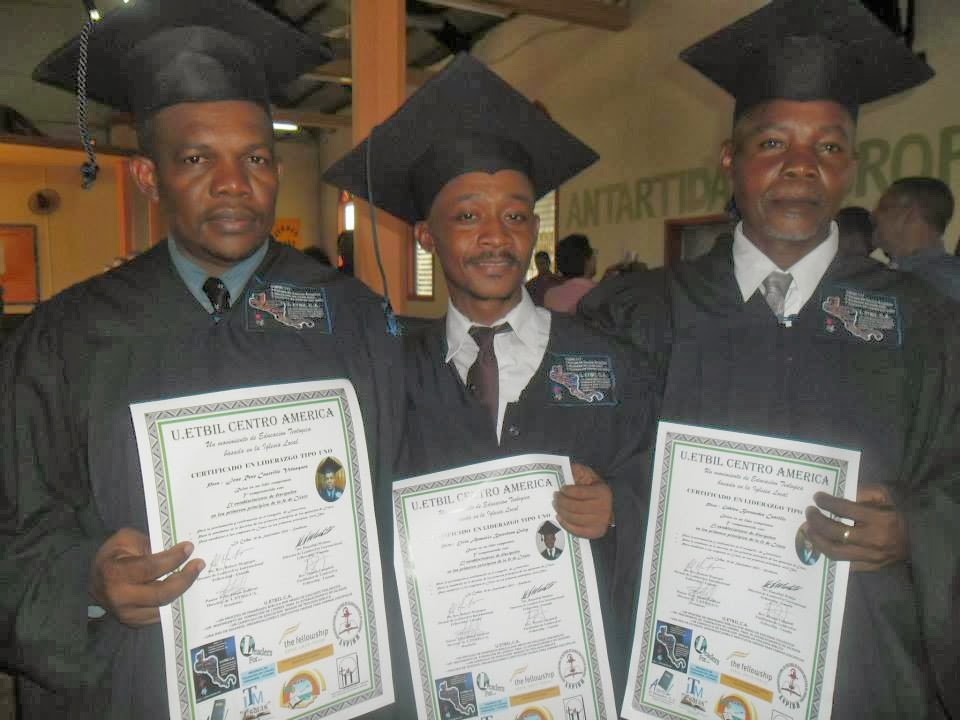
Several weeks ago I (Fernando) had the joy of seeing pictures of Garifuna seminary students, our brothers and sisters, graduating after completing their first level of theological training. It was also encouraging to hear how much this event meant to their lives. Some shared that they cried for joy, and others told us they had never graduated from anything before in their lives, and it was truly a great blessing to be a part of that experience. I am convinced that these small steps ("Studying the First Principles" series) will help the Garifuna church leaders "show [others] the way they are to live and how they are to behave."


I do not completely agree with graduations in theological studies; I am convinced that theological training should be an ongoing and lifelong process. However, reaching this point is good for reflecting on the journey thus far and for recognizing once again that God has been faithful. My brothers and sisters went through countless difficulties: family conflicts, illnesses, ministry conflicts, and more. But they have persevered, and praise God because He never leaves us to walk alone, and He has shown His faithfulness to these students, His children and servants.


"Those who sow with tears will reap with songs of joy. Those who go out weeping, carrying seed to sow, will return with songs of joy, carrying sheaves with them." Psalm 126:5-6


Friday, May 17, 2013

Bible School Classes: Habits of the Heart

Hi friends! I hope you have had a good week. We have had a busy week with BILD classes here in La Ceiba.

As some of you know, the Garifuna Bible school has pastors and church leaders who meet for one week of classes about every three months. Baptist and United Brethren leaders have also been involved. This group began about a year and a half ago, and they first studied a series on Acts. Since September, they have been taking the four-part First Principles series, covering fundamental areas of the gospel and discipleship. Starting this year, some students have begun implementing the First Principles program in their home churches and communities.

This past week we completed the fourth and final part, Habits of the Heart. We studied and discussed Scriptures related to spiritual disciplines, not only in an individual sense (such as personal devotionals), but the biblical basis for habits as families, church families, and members of our communities. A core theme was the biblical motivation behind cultivating disciplines, out of a loving response to all Jesus is and has done for us, and the importance of growing together as families and congregations.


John, originally from Canada and now living in Honduras, facilitated discussions. 


Discussions were held in small groups and also with the whole group. 


Times of prayer are more meaningful now since participants have developed friendships over time.


Participants are encouraged to now begin the second series, which focuses in greater depth on God's plan for households and church families. They will meet for the first session in September and also celebrate the graduation of those who completed the first series during this past year. Sadly, Fernando and I will not be in Honduras at that time, but we look forward to continuing with this group when we return to Honduras later this year.

Please pray for these godly leaders to be diligent in their studies as they prepare for classes in September, and for unity and wisdom as they train leaders through this discipleship program.

I will soon post an update about a OneStory workshop I am helping facilitate. Thank you for your prayers and support; we are thankful for what you do to make all of this possible!

Monday, May 6, 2013

Two New Training Groups

Hi friends!

Thank you to all who have prayed for Fernando as he has helped coordinate new training groups through the Garifuna Bible school, using the BILD International training method. We invite you to praise God with us for what He has done and continue to lift up these new leaders and participants in your prayers:

La Ceiba
Eduardo, who pastors the church where we have served here in La Ceiba, has also begun discipleship classes using this method, and about 20 people are currently participating. We have heard positive feedback from those who have said they are learning new things about the Bible and by engaging in discussions about how it relates to their lives.

Corozal
Elvis, a young assistant pastor from Río Esteban, has shown great commitment in his studies and has also been an invaluable aid to Fernando. The last weekend of April, Fernando and Elvis launched a training group in Corozal, a community near La Ceiba. Ten pastors and leaders attended the first session of the BILD program, but about 18 total are expected to participate. Elvis will continue leading the group when Fernando and I leave next month.

Limón
Last month David, José, and Félix launched a group of 12 participants in the community of Limon. You can watch video clips featuring David and José.

Punta Piedra/Cusuna/Ciriboya/Iriona Viejo 
This past weekend, Fernando took a trip to the more rural communities east of here, near Sangrelaya, where he is from (posts about Sangrelaya: here and here). On Saturday, he and Gabino, Nahum, Lidia, and Emilio launched a training group for these four communities. We praise God that 30 people came and more are interested! You can see pictures of Lidia and Emilio and a video of Gabino.

Fernando said it was encouraging to see how the materials in Garifuna were quite helpful; people enthusiastically participated in readings and discussions. Most people in that region are fluent in Spanish for education and work purposes, but it is much more natural and meaningful to communicate in Garifuna, particularly with respect to spiritual and personal matters. These four communities are home to several churches, but most pastors and leaders have not received theological training, so we look forward to how the Lord will use these studies to help them grow as leaders and train others.

Please pray for each of the leaders who will be leading participants in the content they have already studied. Pray for them to have unity, lead in the truth of God's Word, and have perseverance as they lead this new group.
  • La Ceiba: Eduardo (20 participants)
  • Corozal: Elvis (18 participants)
  • Limon: David, Jose, and Felix (12 participants)
  • Punta Piedra/Cusuna/Ciriboya/Iriona Viejo: Gabino, Nahum, Lidia, and Emilio (30 participants)

Next week we will have the next session of Bible school classes with the group of leaders who have been studying during the past year together. Since our last session in March, we have studied individually and in small groups the material to be covered next week. Please pray for safe travels from their communities, for those who will be facilitating, and for the Lord to work in our hearts and prepare us to disciple others.

Thank you for joining with us through your prayers and support!

Friday, March 8, 2013

The Church's Mission: Bible School Classes (Mar.)


This week Garifuna Bible school students met in La Ceiba for the third session of classes in the current BILD International training program they are taking (the first session was in September and the second in December). Fernando has been coordinating the general logistics of the program and, specifically, the Garifuna pastors and leaders who participate. Pastors from Baptist and United Brethren churches also are participating.

This week's topic was about the purpose of the church: evangelism, discipleship, and establishing churches. Students had studied the Bible passages and exegetical information in the past few months, and they also had met in small groups in their regions to discuss the information. Pastor Felix, who has been facilitating classes during the past year, also taught about leadership formation and how to continue to grow as leaders while helping others develop, as well.


Several students volunteered to lead discussions with their peers in preparation for teaching new groups forming in their own communities:

Tia Lidia, from Cusuna, where a new group will soon start

 Pastor Emilio, from Punta Piedra, who will help start another group


We could see that participants were encouraged to see each other again and share what God has been doing in their ministries and personal lives. Several talked about how God has worked in their hearts and families since the last time they met, when the topic was about God's design for individual families and His church to be a family. Others told us that they have begun to teach this same program to potential leaders in their own communities and churches.

Pastor Castrillo shares about his experience in the program, how God is helping him start a training group in his community, and how we can pray for them:


We are thankful to see their commitment not only to learn and grow as ministers of the gospel, but also to train others in understanding, teaching, and living out God's Word.

"Let us hold unswervingly to the hope we profess, for He who promised is faithful. And let us consider how we may spur one another on toward love and good deeds. Let us not give up meeting together, as some are in the habit of doing, but let us encourage one another -- and all the more as you see the Day approaching." Hebrews 10:23-25
 
Please pray for: 
  • Pastor Castrillo and the others who will start teaching, that the Lord will give them wisdom, unity, and vision as they begin training new leaders.
  • Fernando and Elvis, who will be coordinating and supporting those leading new training groups.
  • This group of students as they continue studying and prepare for classes in May, that they will be diligent in their studies and led by the Holy Spirit.
  • That the Lord will raise up leaders who are faithful to His Word and to the Great Commission both in Honduras and beyond. 

Thank you for supporting this program through your prayers and partnership, not only investing in these servants, but also in those they minister to!

Friday, December 7, 2012

Family of Families: Bible School Classes (Dec.)

"Consequently, you are no longer foreigners and aliens, but fellow citizens with God's people and members of God's household." Ephesians 2:19


The topic of this past week's Bible school classes was "Belonging to a Family of Families." Since the last session, in September, students have been studying Scripture that addresses God's design for families and His church, which He refers to as a family. It was a time of digging more deeply into the Word, sharing rich discussion about how it relates to our own families and church ministries, and being convicted and encouraged as the Lord spoke into our lives.


We found several recurring themes throughout the week. One was that we must live what we say and be an example to others in such a way that draws them to Christ and into His family. Another was the deep need we encounter among people who have experienced broken homes. A beautiful aspect of this week's classes was how the Holy Spirit used the Word to bring together pastors from different cultures and denominations as they learned from each other and enjoyed fellowship together.


We were blessed by our teachers: Felix (middle), a Honduran pastor, along with Mario (left) and Dennis (right), who came from Toronto to join us. Mario is originally from the Philippines, and Dennis from St. Vincent. This was a big highlight for the Garifuna pastors, since St. Vincent was where the Garifuna people came from.


I translated between English and Spanish for pastor Dennis:


As we concluded this week's session, there was a special time of worship and prayer together:


Just like last time, we would like to introduce you to another Garifuna pastor. In this video clip, Pastor Gabino shares about his experience in the Bible school and how you can pray for him:


Thank you so much for praying for these pastors' studies and ministries. We praise God for this opportunity He is giving them to receive training as they serve in their communities, and we remember that you are a big part of making that possible. Pray that the Holy Spirit will guide them as they apply what they have learned to their families and congregations.

We invite you to praise God with us that the first set of materials has been translated into Garifuna and is now in the revision process. Please pray that this will be a helpful tool for training leaders and building up the Garifuna church.

We also are excited to share with you that some pastors will begin implementing in their own churches the materials they have been studying this year. They need prayer for wisdom in choosing "Timothy"-type leaders to disciple, as well as continued diligence and perseverance as they continue their own studies between now and February, when we will meet again. We look forward to reporting to you what God does then!